I learned a new word: Tsundoku. It’s a portmanteau (another new word I learned) of the Japanese words tsunde-oku (to let things pile up) and dukosho (to read). Tsundoku is the act of buying books and letting them just pile up without reading them. According to Tanner Garrity, it’s supposed to be an expression of the individual’s healthy relationship with continued learning as well as an admission of not knowing it all.
I am a tsundokuist (this word I made up). I buy books three-at-a-time only to forsake two, reading just the one before buying three more. It’s like Antoine Wilson describes in Literary Hub, sometimes I start one of the other two books but rarely finish. I get distracted and start one of the newer three. But it has to stop.
It’s just not the “tiny apartment” and “tiny paycheck” that Tanner describes. It’s that I’ve felt the humiliation of meaning less to someone I loved than their “piles.” I don’t want to be guilty of victimizing anyone I love like that. Yes, it always hurts to give up my books (my tokens of comfort) but I know the sadness will pass. And I have to question why I have given such significance these inanimate piles in my life? You just have to watch one episode of Hoarders to understand how easy it is to rationalize the disease.
I don’t want to be sick anymore. I want to be on a path to healing. Rejuvenation. My immediate diet and prescription? I am going to read all the second- and third- books I’ve bought at New York Comic Con over the years and then I’m going to either put them back on my bookshelf, donate them, or sell them, starting with Vault Comics.
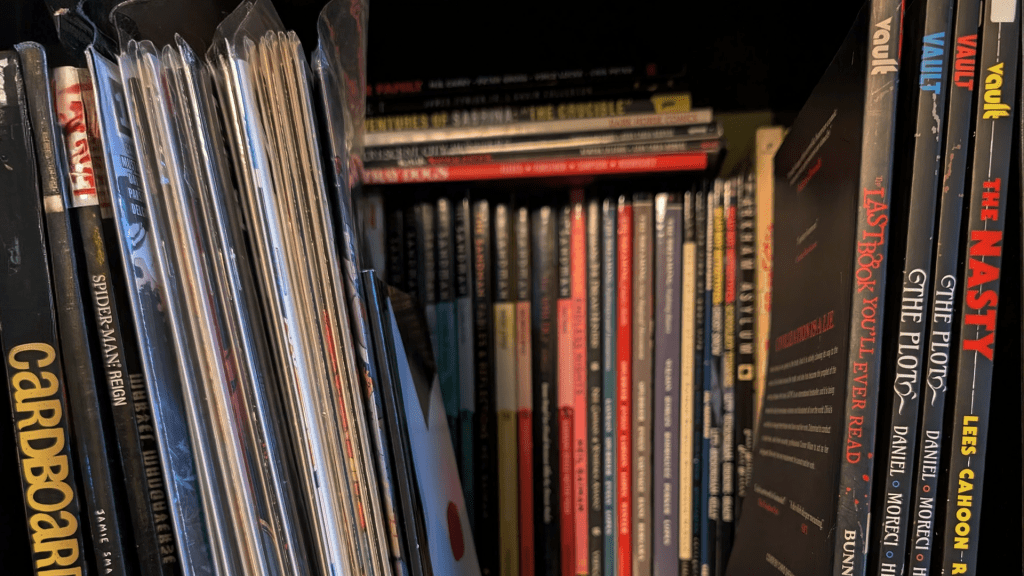
I bought three books from the Vault Comics booth at the 2024 New York Comic Con: The Last Book You’ll Ever Read by Cullen Bunn, The Plot Part One and Part Two (technically two books but I’m counting them as one) by Michael Moreci and Tim Daniel, and The Nasty by John Lees.
I saw a copy of These Savage Shores by Ram V on their table while meandering through the exhibit hall. I had read it a few years before then and made an audible comment about the strong impression it left on me. The woman working the display table acknowledged my comment and we began a brief conversation that lead to our mutual admonishment of the increasing number of book bans that were being reported, which segued into her recommending The Last Book You’ll Ever Read.
The Last Book You’ll Ever Read adds an occult element into the debate and toys with the notion of whether all the gruesomeness is in your head. I questioned whether Connor’s intimate encounters with Olivia and the demons he saw were real or hallucinations. Connor is Olivia’s bodyguard. If I am correct about the hallucinations, then I feel that they could have been better portrayed visually. I needed a more obvious visual cue. I also agree with the Goodreads reviewers who implied that book was repetitive and didn’t go anywhere.
I enjoyed the reveal and even the ending (contrary to some of the other reviewers) but feel they were both unearned. The story progressed but it didn’t develop. It didn’t explore the premise of how books impact social behavior. Or why they always seem to be blamed for it? It didn’t explore why Olivia wrote SATYR. Was it her first book or did she have others? It didn’t explore Connor’s background and why the book influenced him differently. Or did it?
The Plot is my favorite of the three Vault Comic books I bought that day. It tells a familiar story very well. All the supernatural horror tropes are presented: the warning from a deranged family member that is promptly ignored – “Don’t go in the attic!”, the catchy forewarning – “You must first give to receive!”, the bloody bargain with a supernatural entity, and the dire consequences of reneging. It makes me nostalgic for the horror comics I read (sometimes skimmed depending on the fright level) as a pubescent in the 70s.
Parts One and Two of The Plot are the “second” book I bought that day. I count them as a single book because they are each just 130 pages and begin and conclude the same story arc. It’s a creature feature involving a Swamp Thing-like bog monster. The result of a deadly ancestral bargain. The creature hunts down members of the Blaine family who do not “first give to receive.”
The Nasty sits firmly in between The Plot and The Last Book You’ll Ever Read. Set in 1990s Scotland, The Nasty tells the story of teenager Graeme, his imaginary friend, Ennis, and their group of corporeal friends, the Murder Club. The Murder Club meets regularly at their local video store Monster-Dome to share their passion for horror movies. Monster-Dome’s owner Deb is a sort of patron to the group. She provides them with the space and snacks to watch the movies.
Deb’s plan is to revitalize her store by inviting a renowned horror convention to the town and debuting the film. When the tape is eaten by her VCR, Graeme proposes the group make their own horror movie in its place. Ennis somehow becomes corporeal too and becomes the homicidal monster in their movie. This is when the trouble starts.
Though I felt it was a little oversimplified, The Nasty effectively addressed the changing social dynamics that come when people and places grow older. This includes social norms (I didn’t mention that the group also must tussle with a moral decency activist), places like your local video store, and personal growth.
As I finish writing this, I’m feeling like I’m going to hang on to The Plot and The Nasty and either donate or sell The Last Book You’ll Ever Read. Of the three books, I feel it’s the one I would refer to the least.
 Vincent Young
Leave a comment