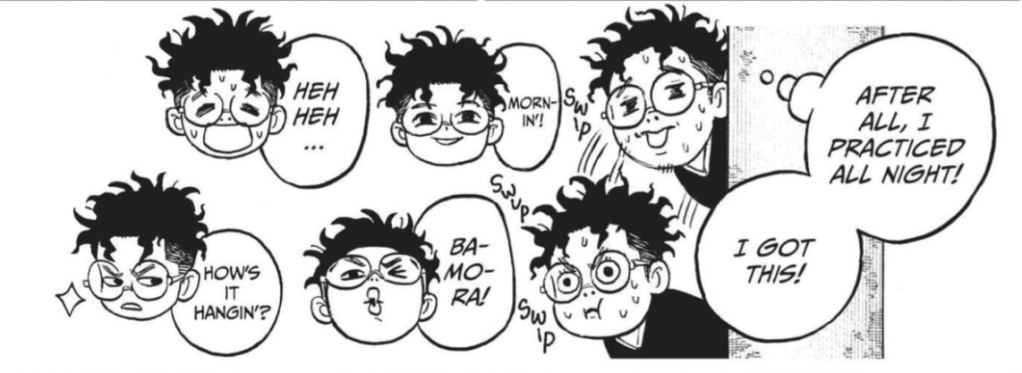
Dandadan by Yukinobu Tatsu can be read as an allegory about male pubescent ascendance and anxiety.
Or it can just be fun.
It can be a silly immature schoolyard joke that the author has imagined into an exciting fast-paced supernatural horror comedy.
According to Anime Hunch, Yukinobu Tatsu wrote Dandadan as a desperate final effort to have an ongoing series. His illustrations were well received but his stories failed to gain any traction among manga editors. He was at the point of giving up when his editor, Shihei Rin suggested he “draw freely without thinking about anything even if it is just one page.”
Dandadan is the result of Tatsu’s “free drawing.” Similar to Keuroac’s automatic writing, it is a reflection of what popped into Tatsu’s mind at the moment he put pen to paper. In fact when it caught the attention of publishers, Rin says Dandadan didn’t have a concrete plot! One wouldn’t emerge until Chapter 3.
On the fun side, Dandadan is about high schoolers Ken “Okarun” Takakura and Momo Ayase’s battle against aliens and supernatural demons and spirits. The Serpoians are aliens who are no longer able to reproduce on their own. They harvest the male genitalia of other species or impregnate the species’ females in order to propagate their own species. In this case they want to take Okarun’s genitals or have intercourse with Momo.
(Having written it out, the plot sounds dark, but remember, this is written from a perspective akin to a middle schoolers, so it ignores the horrific adult aspects of body mutilation and sexual coercion.)
In addition to battling against the Serpoians, Momo and Okarun must also fight to retrieve the latter’s genitalia from a demon called, Turbo Granny, a demon spirit that “eats” male genitalia. She has taken Okarun’s genitalia because he “offended” her. However, as an unexpected consequence, she has left a part of her soul in Okarun, which enables him to turn into a powerful demon like her.
On the allegorical side, Okarun and Momo’s troubles can be interpreted as symbols for the internal and external pressures associated with a child’s development from puberty to adolescence. The Serpoians desire to sleep with Momo could be interpreted as a young girl dealing with intensifying sexualization of her body by strangers or “aliens.”
Okarun’s loss of his penis and testicles could be interpreted as the feelings of “asexualness” that a young boy might feel as the sexual urges of his peers awaken while his own urges are napping still. There is a moment depicted in Volume 2, where a group of boys brusquely ask Okarun if he has had sex with Momo. He lashes out at them in chivalric defense of her reputation.
The boys are shocked by his reaction and rationalize their rudeness by saying it’s because Momo is attractive, which initiates several comical pages where Okarun has to stop himself from thinking of Momo “in that way” – even during an alien battle!
Peer pressure has been difficult for Momo too. She has to grapple with the new landscape painted by her friends’ own “awakenings.” Because she has been spending time with Okarun her friends believe he is her new boyfriend in spite of her denials.
This is complicated by their witnessing her and Okarun’s awkward encounters. For example, in Volume 2 Momo and Okarun trip, fall into each other, and their lips accidentally touch. This is witnessed by many of their peers, who immediately believe they intentionally kissed, so they go on to create a boyfriend-girlfriend relationship between Momo and Okarun, and begin speculating about the details of their relationship.
Momo must also contend with her own deepening understanding of relationships. She starts the book with an abusive boyfriend because he has the same haircut as an actor she idolizes, Ken Takakura. He is known for portraying “Chivalrous gangsters.” In fact, he was so good at it that his name is synonymous with the Ninkyo (chivalrous gangster) genre.
Her idolization of the actor is why she creates the nickname “Okarun” for Ken. Physically, he is the complete opposite of her actor idol. However, in behavior and spirit, he is very much like the characters Takakura (the actor) portrays on screen.
It could be proposed that Dandadan’s supernatural horror setting is itself symbolic of burgeoning adolescent relationships and sexual feelings. According to Anime Hunch, Tatsu “is not a fan of the pure horror genre, however if a mistake is made to express the fear factor of the genre it can become funny.” Tatsu cites Sadko vs Kayako as his inspiration because it is “ridiculous in a good way.”
Sadko vs Kayako is most easily described as the Japanese Freddy vs Jason with the spirits from Ringu(The Ring) and Ju-On (The Grudge) in place of Freddy Krueger and Jason Voorhees.
I don’t know if Dandadan will break any new ground or introduce some grand aesthetic or philosophy, but its pubescent humor is fun and Tatsu balances it well with the subtle development of the deepening relationship between his two protagonists.

 Vincent Young
Leave a comment